Flat & Low-Slope Roofing
Ninety per cent of flat roof failures happen at a penetration or a termination — so that is where the money goes.
- From
- $700 / square
- Life
- 20–30 years
- Systems
- TPO · mod-bit · silicone
- Warranty
- 10-year workmanship
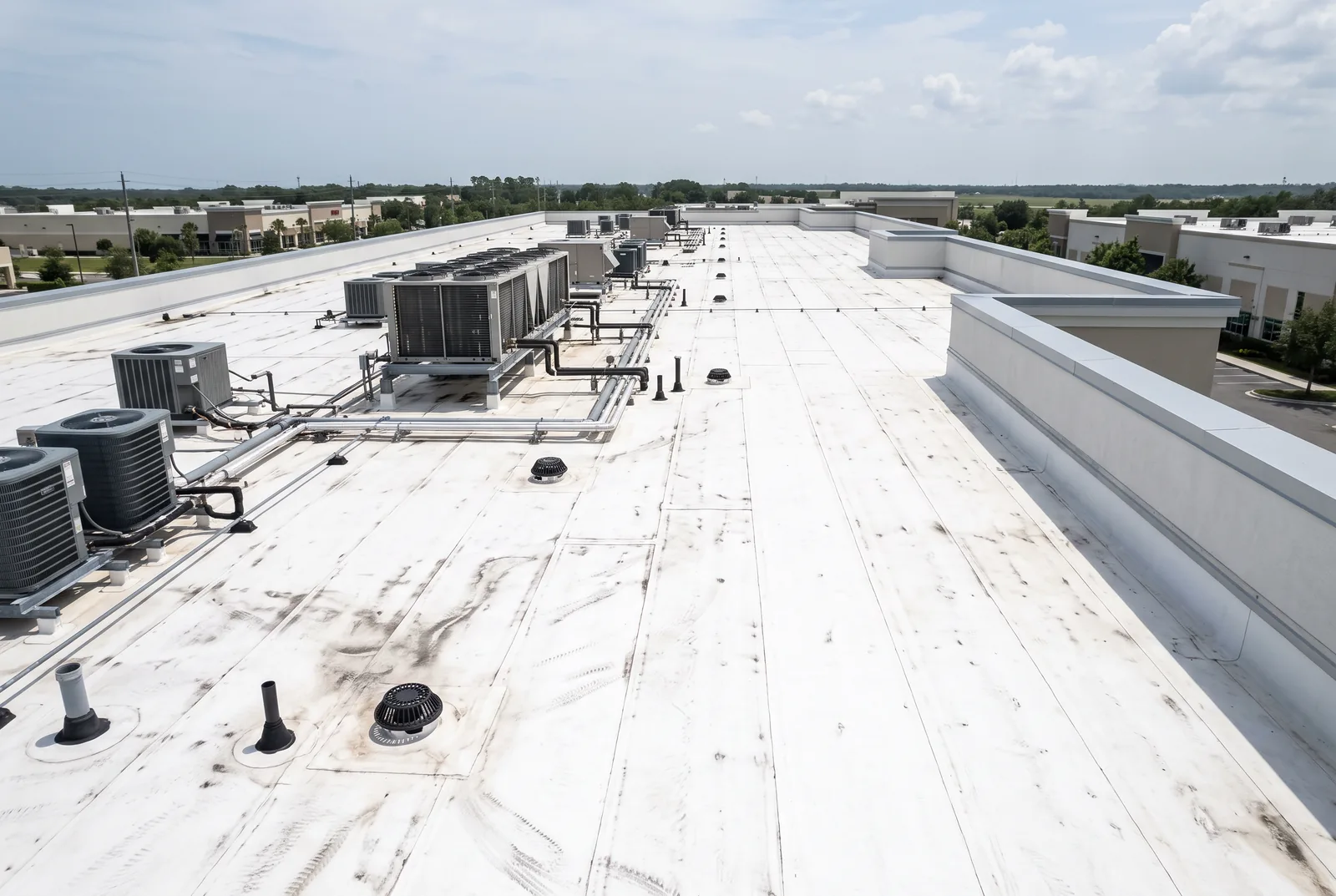
Flat roofs do not really exist — every one has a slope, and the question is whether it is enough to get water off before it finds a seam. In Southwest Florida the combination of intense rain and long dry spells is unusually hard on membrane, and the failures are almost never in the middle of a sheet.
They are at the pipe that was sealed with mastic instead of a boot, the termination bar that was never re-caulked, the drain that sits an inch above the ponding line, or the seam that was welded on a humid morning and never probe-tested. Which is why our quotes look expensive at the details and ordinary everywhere else.
Where ponding is the problem, coating over the puddle does nothing — it just makes a shinier puddle. Tapered insulation costs more and it is the only thing that actually fixes standing water. If your existing membrane is sound and dry, a silicone restoration is a legitimate cheaper option and we will tell you when you are in that case.
What is in the price
Probe-tested welds
Every heat-welded seam checked along its length with a probe before we leave the roof.
Proper boots at every penetration
Pre-formed or field-fabricated boots and clamps, never a bead of mastic and a hope.
Tapered insulation where it ponds
Crickets and tapered build-up to move water to the drains, rather than coating over standing water.
New edge metal and terminations
Coping, drip edge and termination bars replaced and sealed, because that is where wind gets its grip.
Drains and scuppers serviced
Clamping rings pulled, strainers replaced, and scuppers cleared and re-flashed.
Silicone restoration option
Quoted honestly as an alternative where the existing membrane is genuinely sound and dry.
How it runs
- 1
Moisture survey
We check for saturated insulation before quoting — coating over wet insulation traps it and destroys the deck underneath.
- 2
System selection
TPO, modified bitumen or restoration, chosen against the deck, the traffic on the roof and the budget.
- 3
Detail work first
Penetrations, curbs, drains and terminations. The field membrane is the easy part and it goes on after.
- 4
Weld, probe, hand over
Seams welded and probe-tested, then a walk with you or your facilities lead and a marked-up plan of what was done.
Questions on this one
Can you just coat it?
Sometimes, and it is a fair option when the membrane is sound, dry and well adhered. It is the wrong answer over wet insulation or an open seam — coating seals moisture in and you lose the deck. We core-test before recommending it.
Why does water sit on my roof after rain?
Ponding, and it usually means the deck has deflected or the drains sit above the low point. Standing water for more than forty-eight hours voids most membrane warranties. Tapered insulation is the fix; more coating is not.
Do you work on lanai and porch roofs?
Constantly — most Lee County homes have a low-slope section hiding behind a parapet or over a lanai, and it is usually the part that leaks first. It is a small job and we do not treat it as one beneath us.
Free inspection
Get it looked at.
Report the same day.
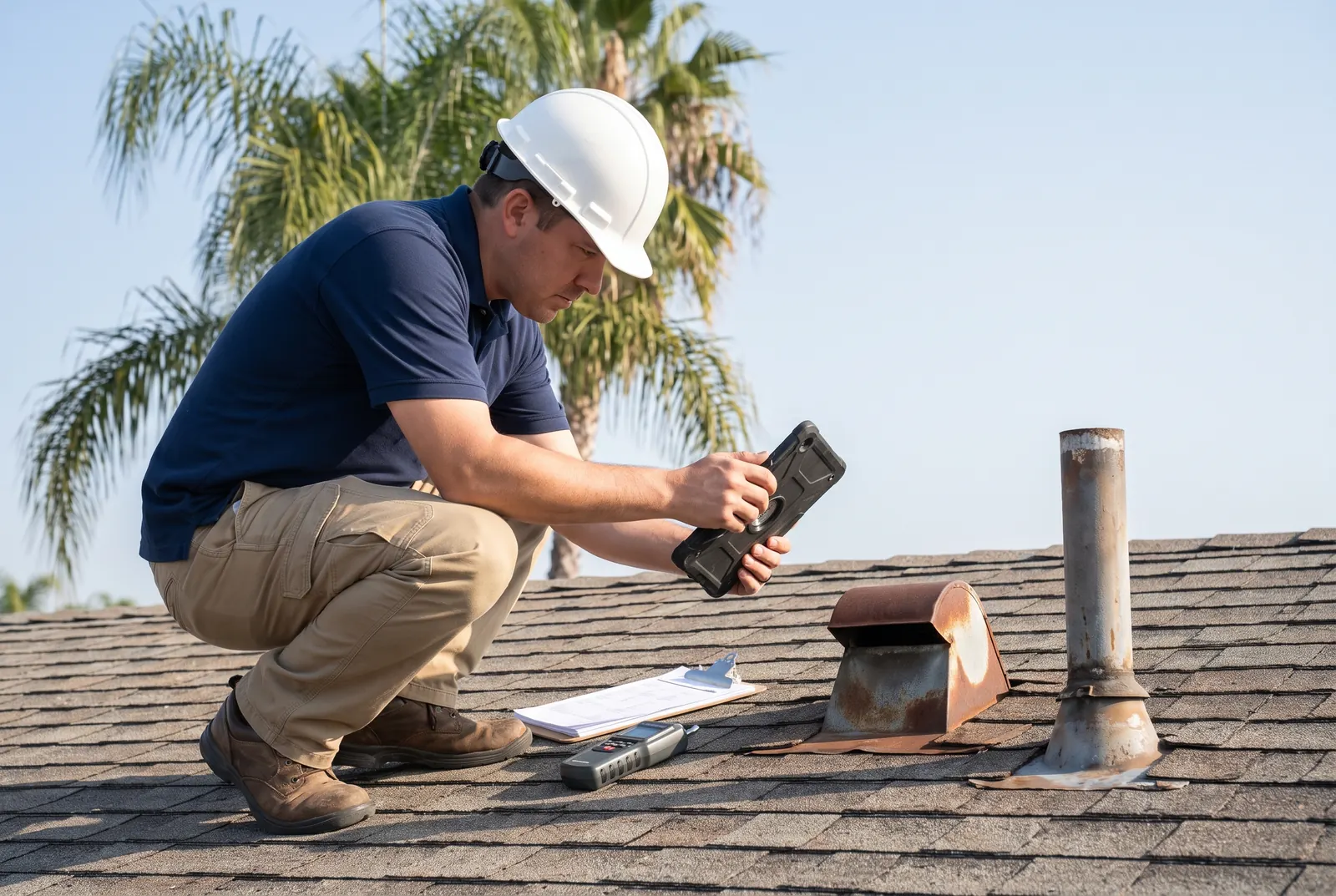
We go on the roof and into the attic, photograph everything, and email you the report — whether or not you ever hire us. No deposit, no doorstep pressure.
Office
Storm line · 24/7
Yard
5641 Division Dr
Fort Myers, FL 33905
Hours
Mon–Fri · 7:00am – 6:00pm
Saturday · 8:00am – 1:00pm
Storm line · 24/7 in season